

Latest News
Sept./Oct. response: Civil Rights Icon Addresses Legacy Banquet Guests
Little Rock Nine’s Elizabeth Eckford Recounts Painful Past
by Audrey Stanton-Smith
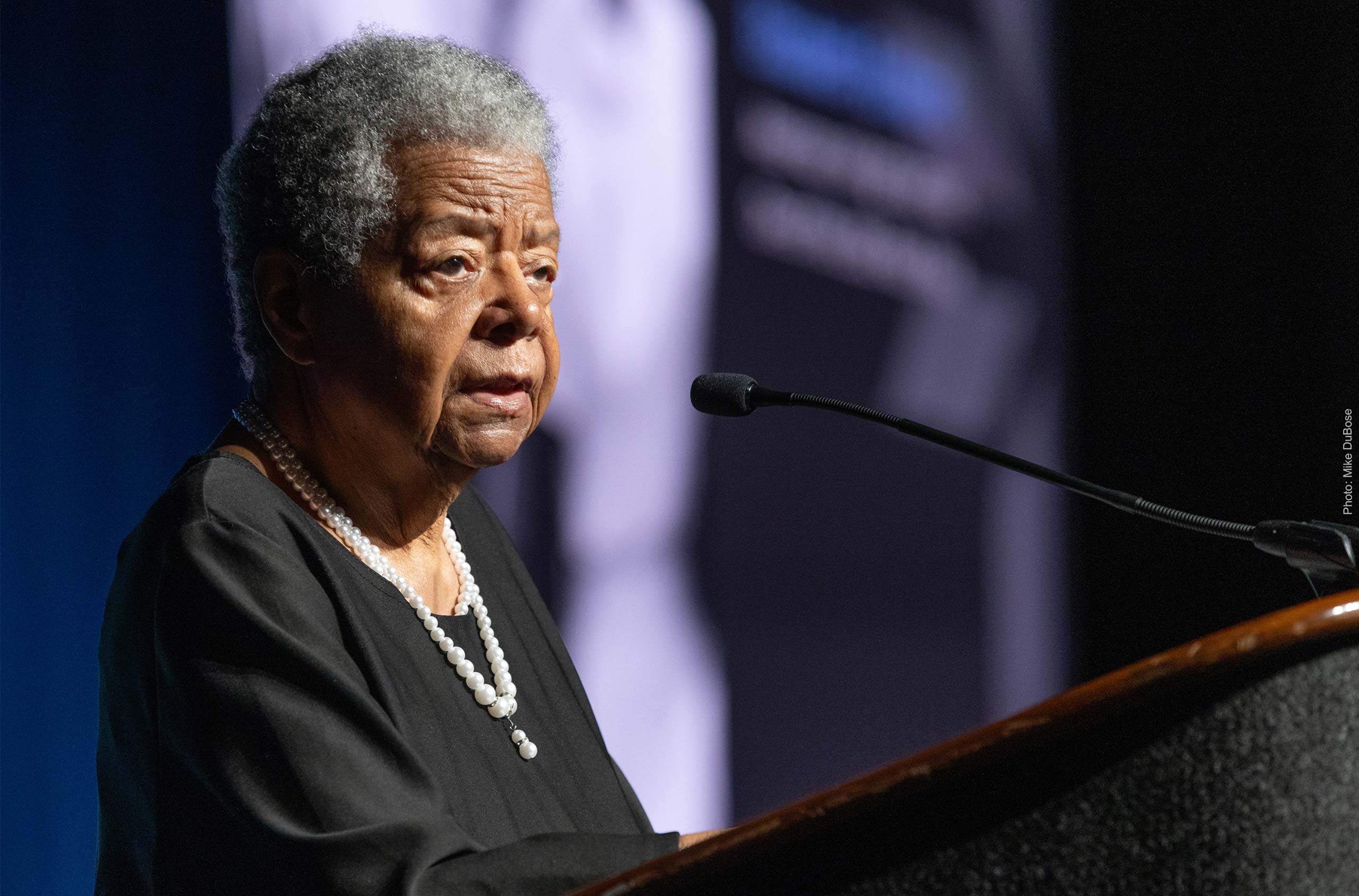
Speaking to a sold-out crowd at the 2026 Assembly Legacy Banquet, civil rights leader Elizabeth Eckford called on United Women in Faith members to act boldly in the face of injustice.
Eckford is a member of the Little Rock Nine, the nine Black students who desegregated Little Rock Central High School in Arkansas in 1957. Photo: Mike DuBose
Eckford became famous as a teenager when she was part of the Little Rock Nine. She is the Black student who bravely attempted to enter Little Rock Central High School on Sept. 4, 1957, while an angry White mob yelled at and threatened her. Though the plan was for her to arrive with eight other Black students attempting desegregation, Eckford arrived on the campus alone because her family did not own a telephone and did not receive the phone call that warned the others to postpone their actions due to impending violence.
That day, photographer Will Counts captured Eckford in a moment that has been called the most iconic image of the Civil Rights Movement. It shows a determined young Eckford, books in hand, walking with grace as an angry White female student jeers.
Eckford and the others eventually succeeded at attending the school, though their path was difficult. She went on to serve in the U.S. Army, teach history, work in departments of welfare and probation, and co-author her autobiography, The Worst First Day: Bullied While Desegregating Central High. In 1999, President Bill Clinton awarded Eckford and the other members of the Little Rock Nine a Congressional Gold Medal, the highest civilian award in the United States.
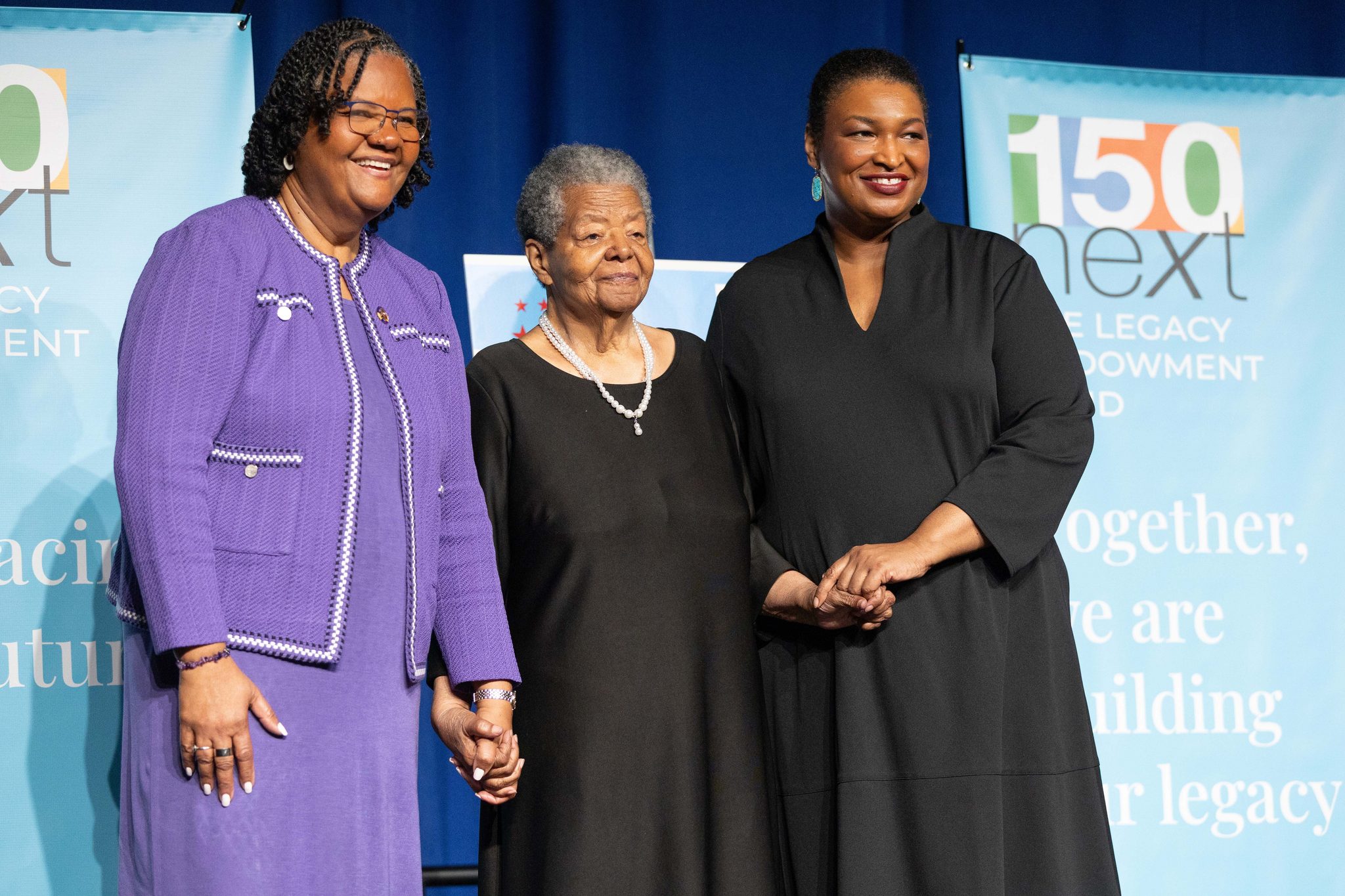
And on the second day of United Women in Faith’s Assembly 2026, Deaconess Christi Campos, executive for Development and Donor Relations, welcomed the “author, civil rights icon, and true legacy herself” to the stage as the keynote speaker at a fundraising banquet for The Legacy Fund, a permanently invested endowment that supports the work of improving the lives of women, children, and youth at home and abroad.
“America’s progression toward equality is not linear. It swings right and left,” Eckford told the banquet crowd. “Language can be powerful. The more things change the more they remain the same. Discrimination exists and varies from place to place.”
Eckford talked about bystanders who deflect by saying they didn’t know or didn’t take part or by saying they would have acted differently if they had known.
“They did nothing. In my book, I urge bystanders to be the change by being supportive,” Eckford said before quoting Dr. Martin Luther King Jr.: “There comes a time when silence is betrayal.”
“Our lives begin to end the day we become silent about things that matter,” she continued. “In the end, we will remember not the words of our enemies, but the silence of our friends. Compassion, empathy, and kindness can be uplifted to those who are alone.
“In every act of bullying, there are three groups: the one who bullies, the one who is bullied, and the one who stands by and says or does nothing.”
Doing nothing about racism and violence, she said, is protecting racism and violence.
“The decision not to act in the face of injustice is a decision in favor of maintaining the status quo. Change begins with recognizing and embracing our individual capacity to act. Learn to see the world from different perspectives. Don’t shut yourself up inside your comfort zone. Take the opportunity to explore.”
Eckford cited her fellow Little Rock Nine participant, Dr. Terrence Roberts, who has urged the nation to confront the past and learn from it.
“We should not be deluded that we have reached some kind of racial equality in our culture. We must not entertain the wishful thinking that racism is a thing of the past,” Eckford continued, noting that she applauds the teaching of African American history and all efforts to teach the true past and consequences of American history.
“Sixty-nine years ago, I was one of the nine Black teenagers who were the first to desegregate all-White Little Rock Central High School,” Eckford said before sharing her memories of that day. “Lessons [were] learned that still apply today.”
A history teacher, Eckford recounted the signing of the Southern Manifesto, a document signed by Congressmen from 11 Southern states that previously made up the Confederacy. The document encouraged citizens to resist efforts to desegregate public schools and was supported by governors in southern states including Arkansas. In fact, Arkansas Gov. Orval Faubus mobilized the still all-White Arkansas national Guard to prevent Black students from entering Little Rock Central High School.
“He told television viewers on the night before I attempted to go to school that he expected violence if Negro students came to Central High,” Eckford said. “The all-White Arkansas National Guard surrounded the school on all sides. The governor said that they were there to preserve peace and order. … Protesters were across the street from in front of the school.”
Eckford noted that even though President Harry Truman had announced that the United States Armed Forces would integrate beginning in 1948, the Arkansas National Guard remained entirely White until 1964. Other change also moved slowly in her home state, including desegregation, a term Eckford said she insists on using in place of “integration.”
Even though she and the others were eventually allowed to attend school, they were not treated as equals.
“We were banned from attendance and participation in all extracurricular activities. No band. No theater. No attendance at football and basketball games. We could only attend class,” she said. “Profound changes occurred gradually over many decades.”
On that first day she attempted to go to school she did not immediately realize the danger.
“There were cameramen, photographers, and reporters from around the world,” she recalled. “I heard protesters out front. … I was turned away three times by the guardsmen before I finally realized that they were there to keep me out.
“Protesters stood behind me as I stepped out on the street. I headed down the street to another bus stop. A man shouted, ‘Hang her! Drive her over across the street and get a rope!’ The crowd screamed threats.”
Eckford recalled how she much later saw a photo of an armed man beyond her that she learned had been sent to see that no physical harm came to her, but at the time, she found her only protection in a few reporters as she walked to a nearby bus stop bench.
“One … stood behind the bus bench, a human barrier, so that people could not strike me from behind,” she said. “Two reporters were seated on the bench and they said, ‘Don’t let them see you cry.’ They tried to comfort me. When one of them stretched his arm out and onto my shoulder to comfort me, the crowds’ jeering rose higher and higher, and they started attacking him. And I heard a woman, a White woman, and she said that they should be ashamed of the way that they were treating a child.
“Why do I still talk about my past? We need to remember that we cannot heal the nation’s wounds unless we understand the origins and history of those wounds.”
Eckford called on those listening to look at history “unflinchingly” and beware of those who want only to look forward without reopening wounds because they are concerned that “pursuing justice might unsettle fragile political arrangements.”
“History’s unresolved crimes do not fade. They continue to shape political and moral landscapes long after the perpetrators have died,” she continued.
“The past remains present until it is confronted. I have a personal mantra that’s in front of my statue on the Arkansas State Capitol Grounds in Little Rock, and it says we cannot ever have true racial reconciliation until we honestly confront our painful but shared past.”
Eckford’s speech received a standing ovation and helped raise more than $189,000 for United Women in Faith’s Legacy Endowment Fund. Her book, The Worst First Day: Bullied While Desegregating Central High, is published by Lamp Press and available through Amazon and other retailers. Eckford also took time Saturday afternoon to sign copies of the book and greet fans visiting the Assembly bookstore.
Audrey Stanton-Smith is editor of response.
