
Latest News
Jul./Aug. response: Year of Influence
Unstoppable Campaign Will Focus on “Share the Good News Everywhere: Influence” Through the Two Social Justice Priorities, August 2026-July 2027
by ELIZABETH CHUN HYE LEE, EMILY JONES, ILKA VEGA, and MARYANN VERGHESE
Unstoppable Campaign
United Women in Faith’s Unstoppable Campaign is a bold, four-year journey from 2025 to 2029 to reach more than 500,000 women with our message of “Real Faith. Real Women. Real Community.”
In the first year, we focused on the theme of Learning the Story: Inspire. During this time, we have been highlighting Soul Care, Mission u, and Assembly as ways that United Women in Faith inspires.
From August 2026 through July 2027, we move to the second year focused on the theme Share the Good News Everywhere: Influence. During this year, the Unstoppable Campaign will focus on the Influence pathway through United Women in Faith’s two social justice priorities: Climate Justice and Ending Mass Incarceration and the Criminalization of Communities of Color.
Throughout the year, you will have may opportunities to engage with the social justice priorities with your United Women in Faith group and your wider community.
Why Social Action
Our call to social action is central to our faith as Christians and is rooted in Scripture and tradition. For more than 150 years, Methodist women have organized for mission to live out God’s call for justice.
As our spiritual ancestors before us, we live out the Micah 6:8 call to “do justice, love kindness, and walk humbly with [our] God” by not only serving the least of these, but also advocating for transformation in the systems and power structures that cause harm to any of God’s creation.
As The United Methodist Church Social Principles state, “By God’s grace, we are called to be more Christ-like, and thus to be merciful, just and compassionate. Responding to that call, we seek to follow Jesus, who gave boundless love to all—the children, the outcast, the condemned and the confused. Jesus calls every generation to wholehearted discipleship: opening our hearts to the people we encounter daily; practicing compassion with our families and neighbors; honoring the dignity and worth of all people near and far; recognizing the systems that destroy human lives through poverty, war and exclusion; and advocating justice and care in our churches, communities and social structures.”
Our two social justice priorities remain urgent issues that directly impact women, children, and youth. The voices of United Women in Faith and members like you play an important role in this work.
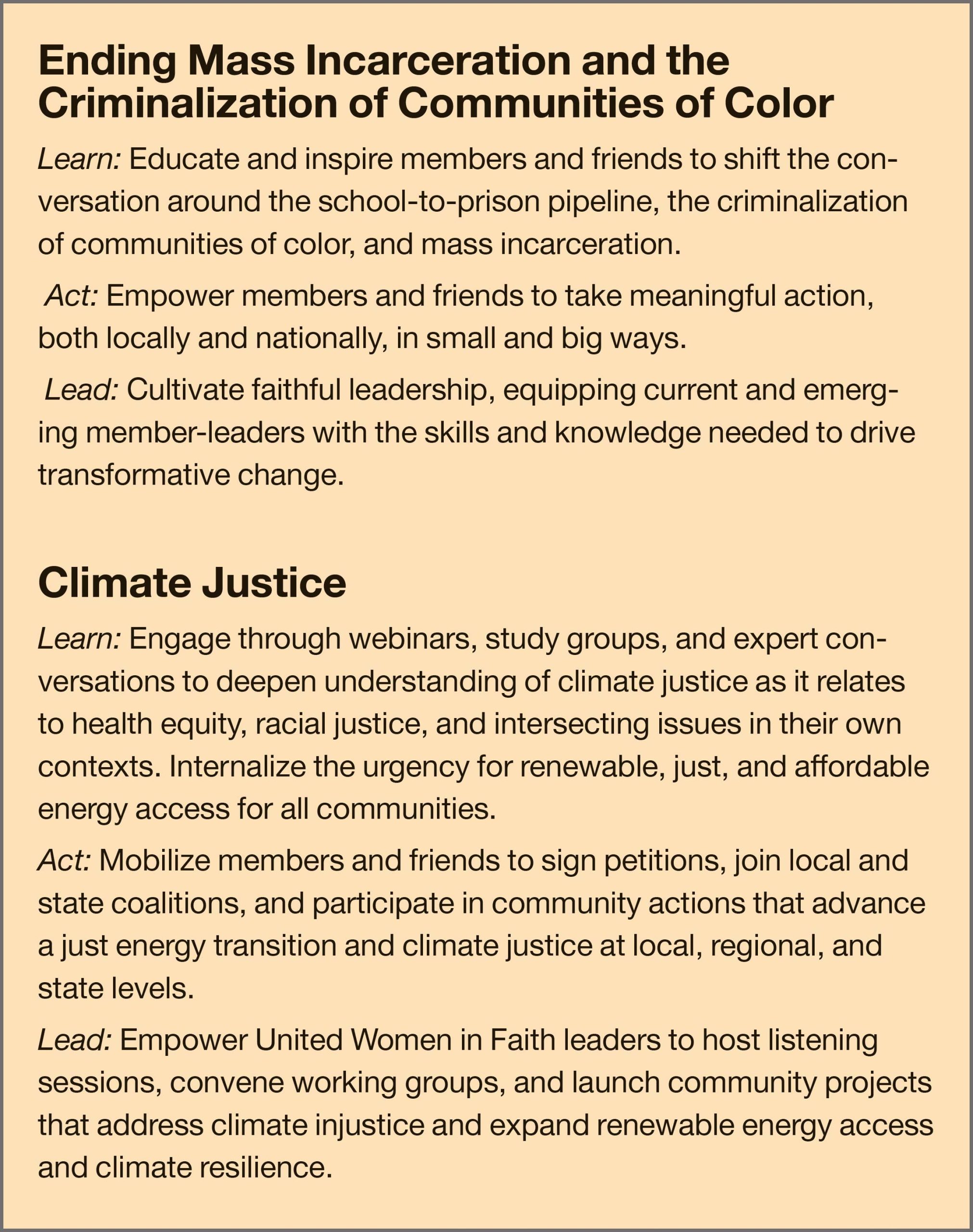
Ending Mass Incarceration and the Criminalization of Communities of Color
United Women in Faith remains committed to our work on ending mass incarceration and the criminalization of communities of color. There are many reasons why this is pressing for us today.
The United States has terrible addiction to incarceration that has resulted in around 2 million people currently held in prisons, jails, and detention centers, according to the Sentencing Project. This is reason enough to declare a moral crisis.
Incarceration is also a women’s issue. We have witnessed more than a 600 percent increase in women’s incarceration since 1980. Many of those women are incarcerated because of the trauma that they have experienced and the ways they responded to that trauma. That is especially true in the case of criminalized domestic violence survivors, women who fought back against domestic abusers with tragic results. Although this is a hugely important and often-neglected social concern, it is true of most incarcerated women, locked up for crimes of poverty, of addiction, and of trauma responses.
This is also a crisis for children and young people. Far too many children are being pushed out of schools, away from educational success. They are being criminalized by racist systems and institutions. This is why we have a special focus on interrupting the school-to-prison pipeline.
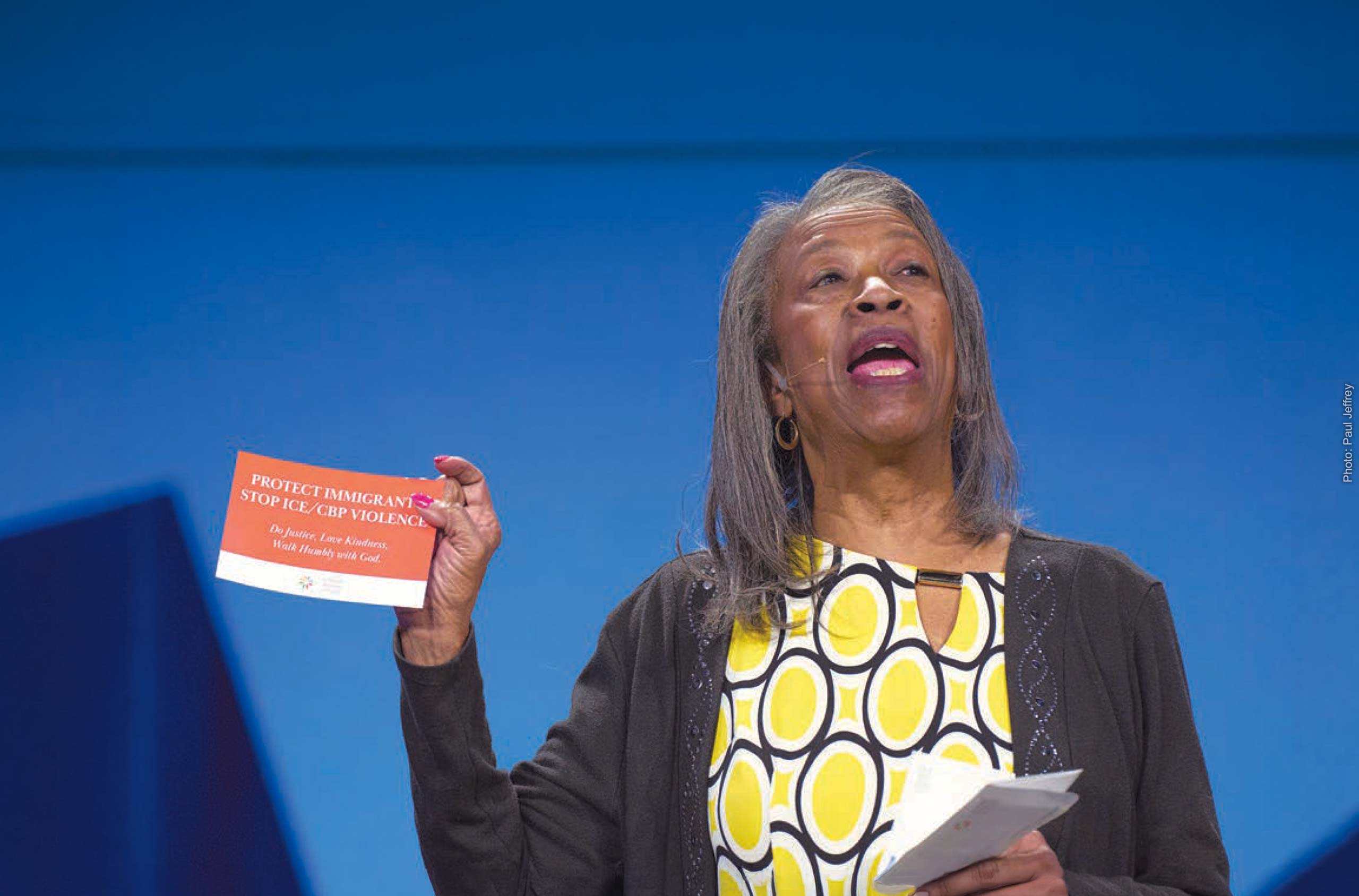
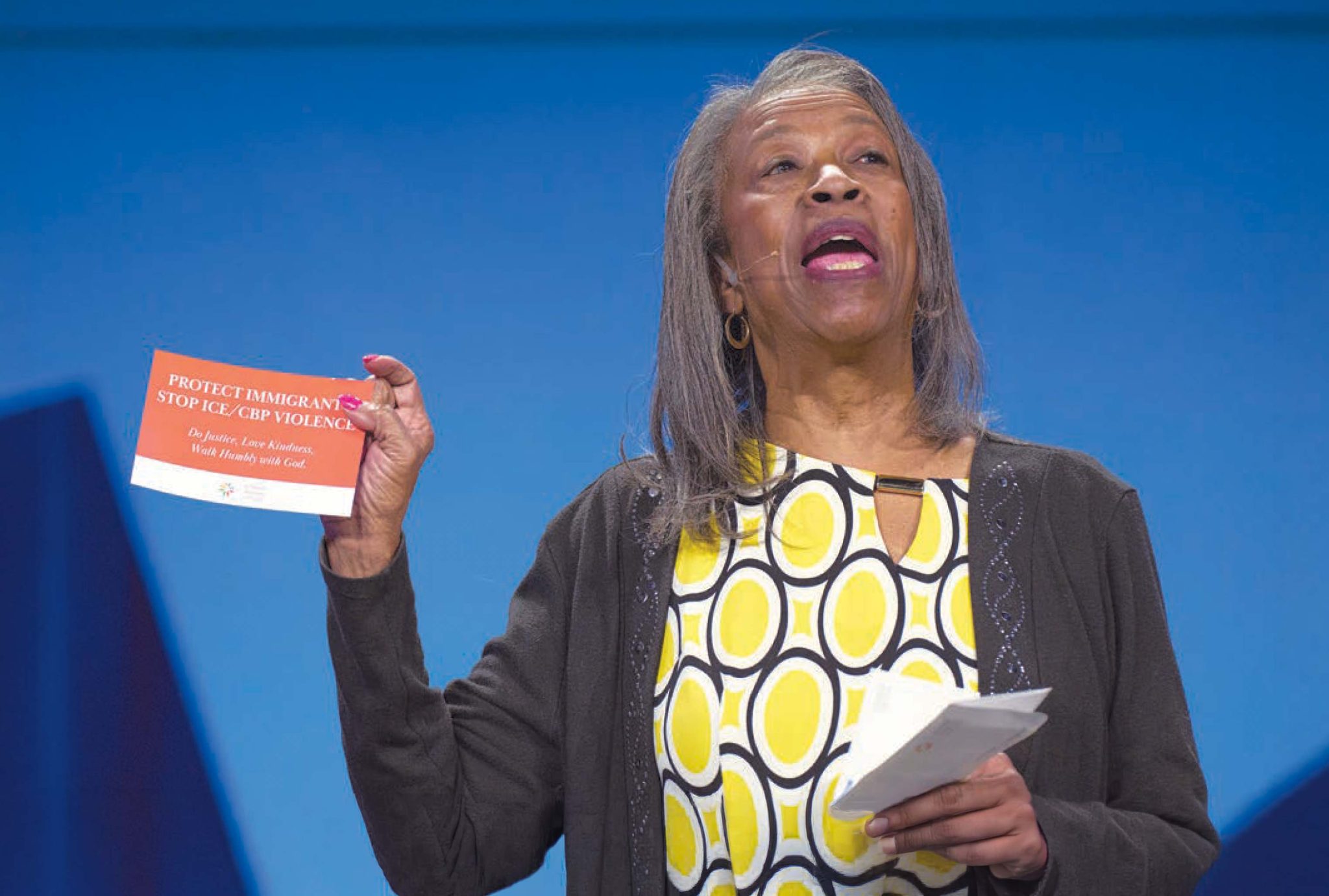
Additionally, when we’re talking about the crisis of mass incarceration and criminalization of communities of color, that is inseparable from the violence that is currently being perpetrated by Immigration and Customs Enforcement and Customs and Border Patrol. This is part and parcel of a big system that is sometimes called “crimmigration.” It is lethal, it is breaking apart families and churches, and it is part of the same racist structures that undergird the criminal justice system.
For these and many more reasons, our focus on mass incarceration and the criminalization of communities of color remains critical.
Climate Justice
Our climate justice priority continues to be a very urgent issue both in our country and in our world. United Women in Faith recognizes the climate emergency is a catalyst for many social injustices we see, and therefore continues to be one of our issue priorities.
Last year, 23 separate weather and climate disasters cost more than $1 billion in damages. Every year we have seen increased frequency and intensity of these disasters, causing greater amounts of damage.
In our communities, that translates to rising temperatures; unpredictable rainfall that causes disruptions in agriculture; and increasing wildfires, sea levels rising, and more.
This impacts our communities and our health, and it affects our most vulnerable communities in many ways.
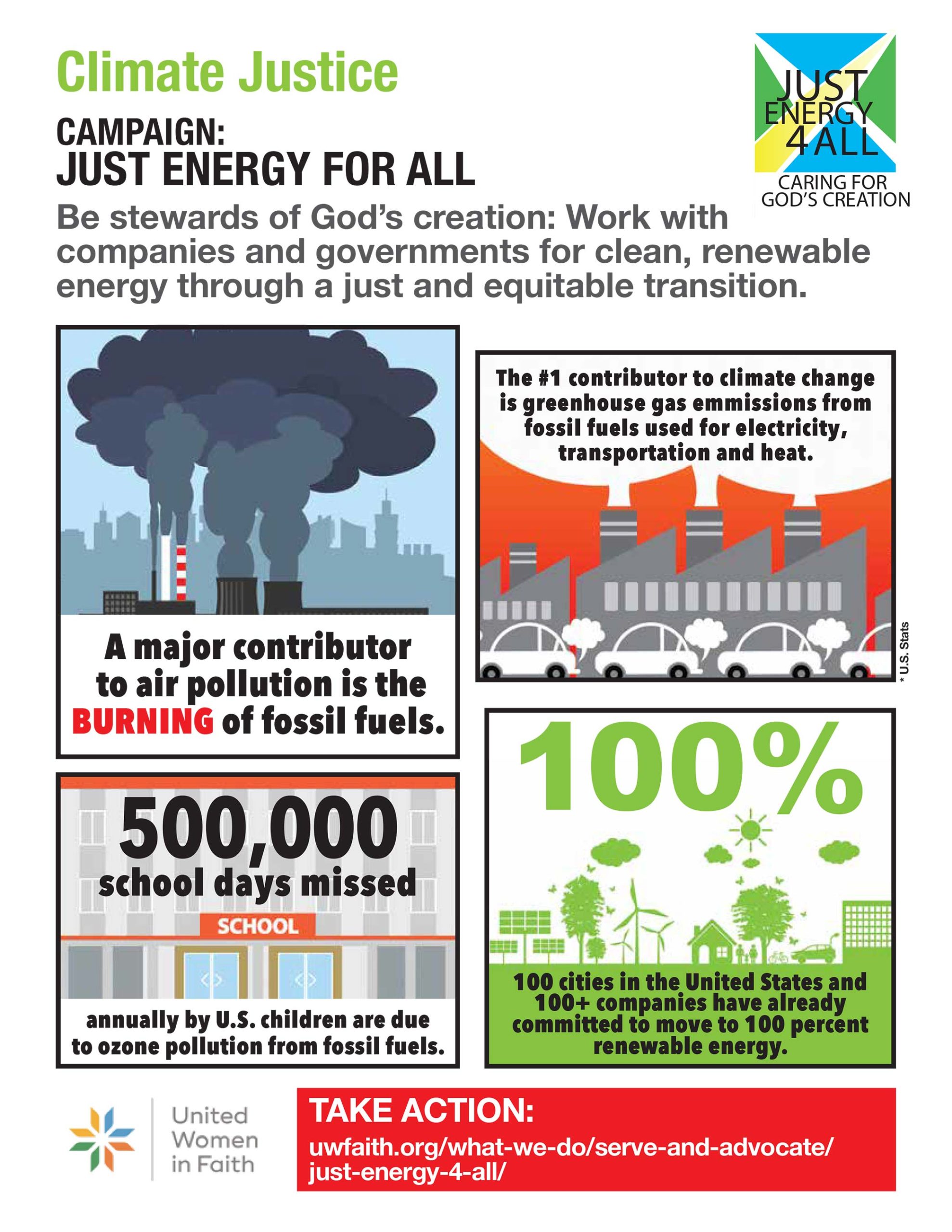
Historically marginalized communities such as low-income communities and communities of color don’t have the same resources to recover from disasters and are more likely to be affected. In turn, they remain more vulnerable to the impact of the climate crisis. Communities of color in particular breathe in 40 percent more polluted air than white communities across the United States. One reason is that they are more likely to be located next to toxic waste sites or Superfund sites.
Our current energy system largely uses fossil fuels for electricity, transportation, and heating, which remain the number one contributor to the climate crisis. Fossil fuels pollute carbon dioxide, methane, and other toxic gases into our communities and atmosphere harming our health and our planet.
Working for a just energy system for all and a transition that prioritizes frontline communities and an equitable distribution of costs and benefits is urgent. We need 100 percent renewable energy that is just in order to lower harmful, polluting emissions causing the climate crisis.
However, we cannot perpetuate the same injustices of the fossil fuel regime. We need everyone, especially historically marginalized communities, to have a say in decisions about our energy system and energy transition. We need to co-envision together a more, just, equitable, and sustainably powered future.
Building on Our Recent
This focused year on influence follows years of work. In the past few years, United Women in Faith has raised the alarm on federal actions that undermine justice, human dignity, and God’s creation and threaten our social justice priorities.
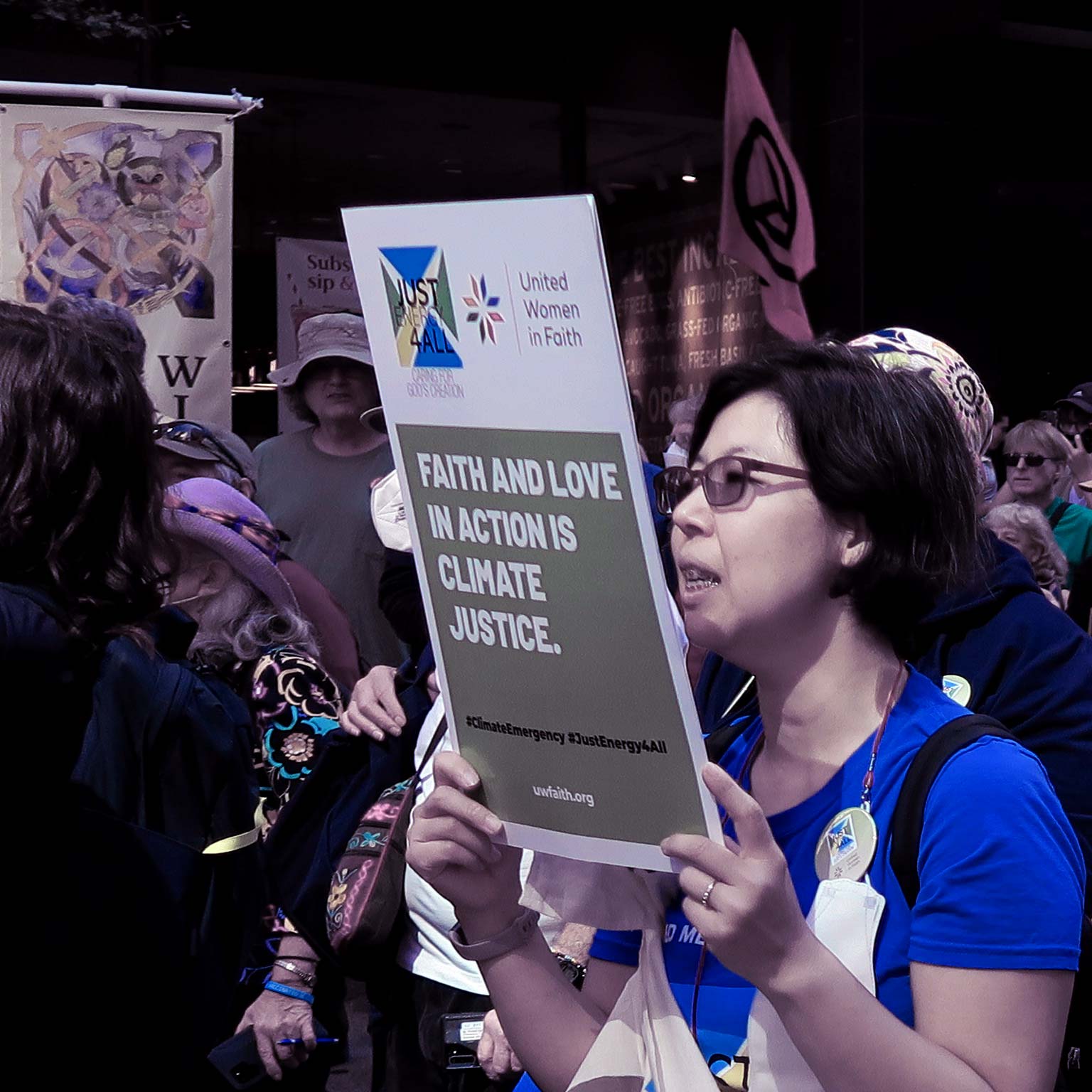
United Women in Faith spoke out against federal policies that dismantle civil rights protections, social safety nets, climate funding, and institutions like the Department of Education, USAID, and the Environmental Justice office of the EPA, as well as policies that fuel the incarceration and expulsion of immigrants.
Last year, United Women in Faith members and friends across all 50 states and Washington, D.C., took more than 4,830 legislative actions. Through e-mails, calls, letters to the editor, and social media posts, members like you urged Congress to support climate justice, interrupt the school-to-prison pipeline, protect communities of color, and strengthen social safety nets.
United Women in Faith partnered with interfaith organizations in prayerful actions and legislative advocacy including “Faithful Witness” vigils and “Pentecost Witness for Moral Budget” actions in Washington, D.C. Across the country, members have joined virtually for these events. In your local communities, units, districts, and conferences, members have organized local advocacy events, legislative days, social justice speakers, educational opportunities, and more.
Many of you have joined the national office for webinars or talks on the social justice priorities, Reading Program author talks, advocacy opportunities, and skills training, such as letters to the editor and opinion essay training. More than 100 members and friends helped develop and test new resources including the Social Action Bible study in this issue and a workshop on practicing difficult conversations around social justice (both available online at uwfaith.org/action).
As we look at this next year of influence, we build upon all this past momentum in our social justice priorities.
Looking Forward
Building on our current educational foundation on our priority to end mass incarceration and the criminalization of color, we will lean into inspiring action and developing leadership.
You will see action and leadership development opportunities that include witness in-person events—like the recent Feb. 25 immigration justice rally in Washington, D.C., the leadership cohort workshops at Assembly in Indiana, and the fall National Prison Summit in Atlanta, Georgia, with SBC21—as well as expanded digital action opportunities.
While wins at the federal level are more difficult at this time, we will continue taking action at local and state levels, where meaningful wins are more likely in the short term.
Thirteen districts and units received seed-funding grants to support local projects to interrupt the school-to-prison pipeline. And educational “learn” content will also continue to be offered both online and in person.
Through webinars, actions, coalitions, and more, United Women in Faith’s climate justice priority continues to work on four key objectives. First, we aim to educate by growing a stronger, engaged base, increasing the number of members involved in climate justice education and advocacy from 10,000 to 50,000 within the next four years.
Second, we focus on advocacy, mobilizing members to support climate justice and a just energy transition in collaboration with Environmental Justice and Climate Justice organizations.
Third, we promote local action by developing and supporting local climate justice leadership. Finally, we aim to grow membership and increase giving, ensuring the sustainability and impact of our climate justice efforts. One way we’ll do this is through seed funding grants for Just Energy for All projects from United Women in Faith groups, local environmental justice groups, and partnerships between the two.
Some of the focus of this year includes combatting air pollution and ensuring that environmental standards are protected and upheld. Additionally, we are building climate resilience and organizing, especially in rural communities, partnering with the Chisolm Legacy Project and the Catalyst for a New Democracy Program, holding community listening sessions, and working regionally on the issues of fossil fuel phaseout through the Climate Justice Action Network, and working on transit equity with the Transit Narrative Change Lab.
How to Influence Through the Social Justice Priorities
In this next year, this is your personal invitation to get involved! We are looking to grow United Women in Faith membership and giving as we influence through our social justice priorities.
Look out for social justice topics and materials at your conference’s annual meeting. Consider how you can make these a priority in your conference, district, and unit.
Need help getting started? One quick action is to use this issue’s “Why Engage in Social Action” Bible study with your unit, church, or other group to start the conversation.
Other Next Steps
- Sign up for updates from both social justice priorities, take a virtual action, and find more ways to get involved at uwfaith.org/action.
- Go further with the Practicing Difficult Conversations Workshop and other resources related to the social justice priorities available on UWFaith Digital and uwfaith.org/action.
- Attend your conference or district annual meeting with social justice priority-related speakers or events.
- Plan a local social justice-related educational or advocacy opportunity. Find an organization in your geographic area that does strong local work on one of the social justice priorities to speak at an event. To support people doing the work, especially frontline affected communities and individuals, we encourage you to provide invited speakers with an equitable honorarium that may vary by place and situation. This would generally be a minimum of $250. (See resources to find a local organization at uwfaith.org/action)
- Save the dates for an Advent devotional around ending mass incarceration and the criminalization of communities of color and a Lenten devotional on climate justice.
- Use the “Campaign Resources” section for more ideas on how to get involved at the member, unit, district, conference, and jurisdiction level at uwfaith.org/mass-incarceration and uwfaith.org/climate-justice.
- Don’t do the work alone! Find trusted partner organizations around you that are working on these issues in your community. Build community with other members working on these issues in your area. (Find more information about partner suggestions under campaign resources).
- Be on the lookout for days of action, webinars, and other opportunities from the national office for the next year!
We are so grateful for all our collective responses to these calls to justice. As we begin this year of influence, think about who you can invite to expand our sisterhood.
Perhaps there are members of your church, a friend who has recently retired and is looking for new community, a community friend who cares about justice, or women who may not yet be involved in United Women in Faith. Consider inviting them to join you.
We know that love in action can change the world. As we grow our sisterhood, we grow our impact and influence. Let’s be unstoppable as we act in faith, hope, and love!
Elizabeth Chun Hye Lee is director of mobilization and advocacy. Emily Jones is executive for racial justice. Ilka Vega is executive for climate justice. Maryann Verghese is mobilization, advocacy, and leadership development coordination consultant and managing editor of response.
